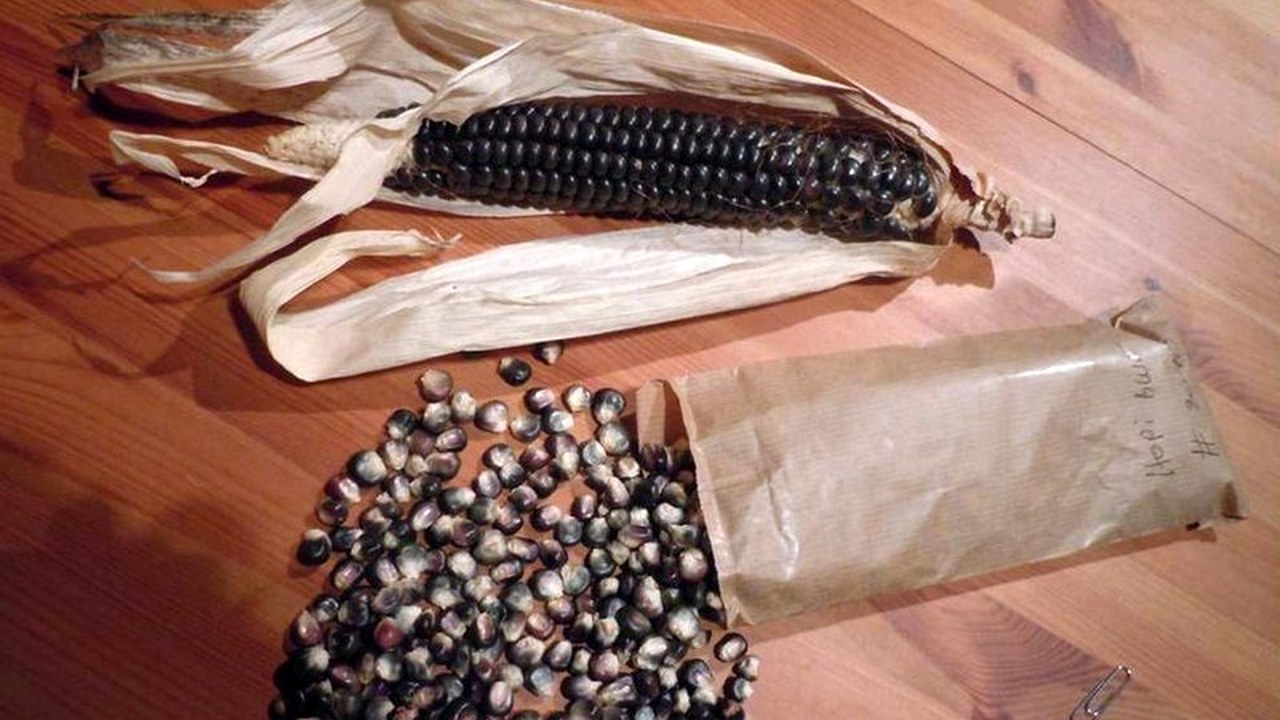
I promised you Hopi Blue corn, so here it is. This is a flour corn, not sweet corn. You don't eat it off the cob in August. You let it dry on the stalk, grind it, and get a soft blue-gray meal for pancakes, tortillas, atole and, in Hopi kitchens, the paper-thin piki bread. This week's Seed to Table is about where it comes from, how to grow it in an ordinary garden, and how to save the seed, which with corn takes more planning than with most crops.
The story: corn at the center of Hopi life
The Hopi have farmed below the three mesas of northeastern Arizona for a very long time, and many families still plant the way their ancestors did. Smithsonian's American Indian magazine ran a long piece on it that's worth your time (The Heart of the Hopi). Hopi life revolves around the corn planted each spring. The colors bred into Hopi corn are tied to directions, and blue goes with the west. In the origin story the article recounts, the clans were given a planting stick, a bag of seed, a gourd of water and a small ear of blue corn.
What gets me is how they grow it. Hopi farmers never irrigate their corn. They scrape away a patch of sandy surface, push a flat digging stick about a foot into the ground, and drop 8 to 12 kernels into each hole so the corn comes up in clumps. The clumps sit five to seven paces apart, and the plants live on winter snowmelt stored in the soil until the summer rains come. Most corn planted that deep would never reach daylight. Hopi corn was selected for exactly that.
It's worth saying plainly that for Hopi families this isn't a hobby. Susan Sekaquaptewa, who is quoted in that article, describes dry farming as a religious practice more than a way to grow food. The Hopi Blue sold in seed catalogs has been grown by gardeners all over the country for decades, and growing it is a fine way to learn what a corn like this can do. Just know whose knowledge it is. Rowen White, the Mohawk seed keeper in Open Sesame, has spent years helping seeds go home to the communities they came from, and her work is a good place to start if you want to understand why that matters.
What makes Hopi Blue special
- It's a flour corn. The kernels are mostly soft starch, so they grind easily into fine meal (Wikipedia has a short explainer on corn types).
- The color is real. The blue comes from anthocyanins, the same family of pigments in blueberries and red cabbage (Wikipedia).
- It comes from dry country. It was shaped by desert farming, though in a garden it still wants water when it's tasseling.
- It's open-pollinated. Save the seed and you get Hopi Blue again, if you keep it from crossing (more on that below).
How to grow Hopi Blue corn
When to plant
Corn wants warm soil, so wait until after your last frost and until the soil is at least 60°F. Hopi Blue needs a long season, about 100 to 110 days to dry ears according to Territorial Seed. In short-season places, plant as early as the soil allows. It's November now, so this is a corn to plan for, and to buy seed for before the spring rush.
How to plant
The garden version is simpler than the Hopi one.
- Plant in a block, not a single row. Corn is pollinated by wind, and pollen from the tassels has to land on the silks. Four or more short rows side by side works much better than one long row.
- Sow 1 to 2 inches deep, with seeds 8 to 12 inches apart and rows about 30 to 36 inches apart.
- Or try clumps. If you want to borrow from the Hopi method, plant several kernels together in hills a few feet apart. You won't plant a foot deep in garden soil, but you'll see how the clumps hold each other up in wind.
- Feed the soil. Corn is hungry. Work in compost before planting, and if you've grown beans in that bed, even better.
Care and harvest
Keep the soil moist while the plants are young and especially while they tassel and silk. That's when a dry spell hurts most. After that, let the ears ride. Flour corn is harvested dry: the husks turn papery and tan, and the kernels get hard enough that you can't dent them with a fingernail. Pick before a long rainy stretch if you can, pull the husks back, and hang the ears somewhere airy to finish drying for a few weeks before you shell them.
How to save Hopi Blue corn seed
Corn is the hardest common garden crop to save well, for two reasons.
The first is crossing. Wind carries corn pollen a long way, and Hopi Blue will cross with your sweet corn, your popcorn or your neighbor's field corn. Recommended isolation distances run from 800 feet to half a mile (SARE) and up to a mile or two when you're preserving a variety (Mother Earth News). Two ways around it for home gardens: plant your varieties several weeks apart so they don't tassel at the same time, or hand-pollinate by bagging the ears before the silks show and dusting them with pollen you've collected from the tassels. You'll see a cross the same year, by the way. If yellow sweet corn pollen reached your blue ears, you'll find yellow kernels mixed in (botanists call that xenia).
The second is numbers. Corn loses vigor fast when it's saved from too few plants. Guides call for about 200 plants to really preserve a variety and 100 as a bare minimum.
- Grow as many plants as you have room for, and save seed from lots of ears, not just your favorite one.
- Let the ears dry completely on the stalk, then finish drying them indoors.
- Shell the kernels by twisting the ear between your hands. Many seed savers skip the small kernels at the tip and the base.
- Mix the seed from all your ears together, so next year's planting carries the whole population.
- Store the seed in a labeled jar somewhere cool and dry.
If you only have room for a small patch, that's fine. Grow it to eat, and every few years start again with fresh seed or trade with someone who grows a bigger block. That's what seed libraries are for.
Is it good for you?
Grind it yourself and blue cornmeal is a whole grain, with the bran and germ still in it. It's also naturally gluten-free, though most baking recipes mix in some wheat flour for structure. If you make tortillas, the old step of cooking the corn with lime, called nixtamalization, is what makes the niacin in corn available to your body. Communities that relied on corn without it suffered from pellagra (Wikipedia).
Recipe: Blue cornmeal pancakes
Piki, the tissue-thin Hopi bread, is a different thing entirely. It's spread by hand on a hot stone, and it takes years to learn. If you ever get the chance to try it, take it. For the rest of us, here's an easy way to use your first harvest.
Ingredients
- 1 cup blue cornmeal
- ½ cup all-purpose flour
- 1 tablespoon sugar or honey
- 2 teaspoons baking powder
- ½ teaspoon salt
- 1¼ cups milk or buttermilk
- 1 egg
- 2 tablespoons melted butter, plus more for the pan
Directions
- Whisk the cornmeal, flour, sugar, baking powder and salt in a bowl.
- In another bowl, whisk the milk, egg and melted butter (add the honey here if you're using it).
- Stir the wet into the dry until just combined. Let the batter rest 10 minutes so the cornmeal softens. Add a splash more milk if it gets too thick to pour.
- Heat a buttered griddle over medium heat. Pour about ¼ cup per pancake and cook 2 to 3 minutes, until bubbles form and the edges look dry, then flip and cook another minute or two.
- Serve with butter and maple syrup or honey. They come out a soft lavender-gray, which surprises people the first time.
Where to get Hopi Blue corn seed
Hopi Blue is easy to find. These are a few good places to start.
- Territorial Seed, Hopi Blue: An Oregon company with good growing notes on the packet.
- Fedco Seeds, Hopi Blue organic flour corn: A Maine cooperative. Their strain is certified organic, and they do sell out of some items, so check early.
- Native Seeds/SEARCH: A Tucson nonprofit seed bank that conserves the crops of the Southwest and northern Mexico. Their catalog is the place to look for Southwestern corns beyond the usual ones.
A corn that Hopi farmers have kept alive without a drop of irrigation. Open Sesame: The Story of Seeds is about the people who keep seeds like this going, and you can stream or buy it here. Missed the last one? Here's how to grow Lacinato kale, the one that gets sweeter after frost.
Next week on Seed to Table: the Cherokee Trail of Tears bean.
Top photo: Abrahami, CC BY-SA 3.0, via Wikimedia Commons, cropped.