The following interview is a transcript of an on-camera interview done with Sean Ludden at his farm in Albuquerque. This interview has been edited for content but may include the occasional transcription error – please don’t blame Sean.
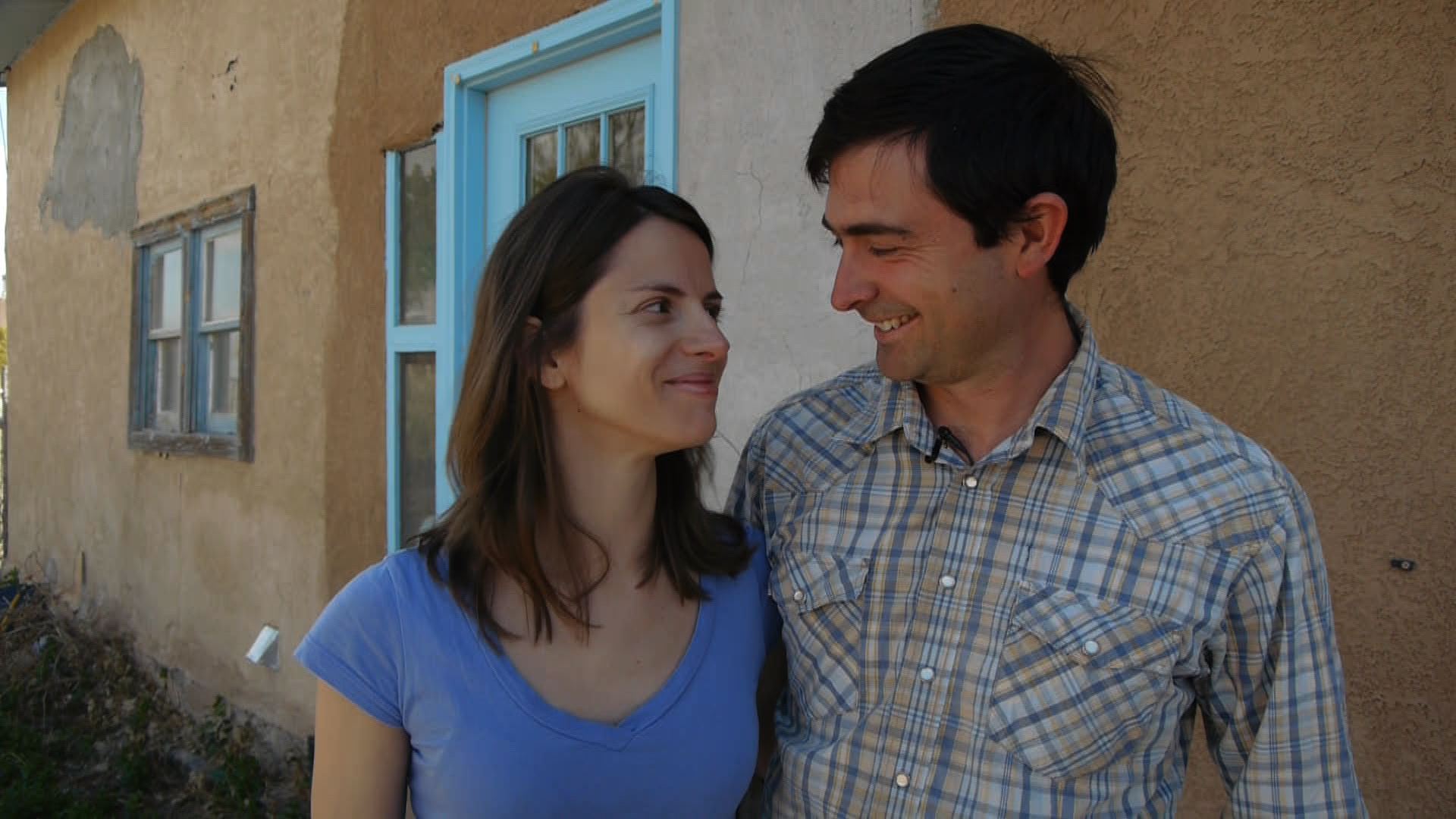
SEAN LUDDEN: My name is Sean Ludden. I’m the Farm Manager at a local non-profit. We provide organic food to the community and help individuals with developmental disabilities. My wife and I also farm here at our farm, Nepantla Farms. The name is derived from a site of transformation. We felt that that was both a metaphor for us worldwide as well as for ourselves. We grow medicinal herbs for local herbalists and culinary herbs for local restaurants as well as food for ourselves. Seed saving is an integral part of that whole process which has been going on for many years for myself and then now since we have land and the ability to do that we’ll be taking that to the next step.
OPEN SESAME: When did you decide that you wanted to do this?

Sean demonstrates seed saving
SEAN LUDDEN: Yes. It came kind of serendipitously. I’ve always been interested in growing food to some capacity. I grew up with it. My parents both had very large gardens – larger than most people. Flowers, vegetable crops and so on my mom canned from those gardens which is what she was taught by my grandma, by her mom. Yes, it really was a part of me as a person. And coming through college and into adulthood, I felt that I really needed to pursue that, really follow through with that. My dad was an avid seed saver and so I think I picked up on that subconsciously and started realizing more and more that this is what I wanted to do with my life. So finding a farm, finding the ability of land to grow on and have that dream become a reality was definitely part of the future for me.
OPEN SESAME: Tell me a little bit more about seeds in particular. So seeds always held an interest to you?
SEAN LUDDEN: Yes. Seeds have always held a really particular interest because that’s the foundation for any farming, any agro-ecological system. Without seeds and good seeds and ones that do well on a particular farm or a particular ecosystem then we’re kind of… We don’t have any background. We have no foundation. Without those seeds, we’re just kind of having this void filled from other areas. With saving seeds on a farm or within a given region, we allow the adaptability for our farming situations. The climate, that’s a big consideration as well. We’ve seen abnormal drought here in the southwest. We’re looking at will agriculture look like in the future. It’ll be resilient. It’ll be diverse. And if we have that diversity within our seed system then it allows to persevere. But if we just buy it from seed catalogs from the northeast or from California or the Midwest and those aren’t adapted to our climate and we’re going to have potentials for crop failure or things that aren’t doing well. At least an idea that I’ve held long with me traveling down to South America, I would see the adaptability of those farming systems. And those were localized farming systems where people have been saving seed for thousands of years especially with old world crops coming in a hundred years. But that allows a really resilient seed to be possible in that system. That’s what I kind of want to mimic in this area. By saving those seeds, getting that diversity in there and allowing those seeds to keep prospering.
OPEN SESAME: When I talked to you on the phone, you were mentioning that you had a conversation with your dad where he was walking along and saving seeds and you sort of had a realization. Can you tell me about that?
SEAN LUDDEN: Yes. This was last year. I had a pretty big realization walking with my dad. He had picked off a seed pod from a tree. It didn’t strike me as odd necessarily but just because of the pursuit of learning about seed saving and so on I asked him, “Have you always done this?” “Yes, I have. Every trip I take out in the southwest and in other areas I would go out and collect seed pods from different plants and definitely the flowers and vegetables in the garden.” And it struck me. I have been around this for so long and there’s definitely some of that that is subconsciously come into my experience.
OPEN SESAME: What made you decide to go to Seed School?
SEAN LUDDEN: Seed School was a wonderful opportunity for me. I was able to have a review for many, many of the technical information but have a group of people that was really cohesive and bring other experiences and technical knowledge to the table. I decided to go there probably two years ago when it started but I couldn’t. We were so busy with farming and with other things in our lives that I wasn’t able to take the time off to do that. I was able to carve out enough time to go down there this April and it was a really wonderful experience.
OPEN SESAME: What are some of your favorite seed varieties?
SEAN LUDDEN: These are a variety of sesame, Afghani Sesame. I got these in a seed exchange a few years ago and I’ve been growing them out. Saturday traffic. It’s a variety of Afghani Sesame that I got in a seed exchange a couple of years ago. It was primarily something just kind of fun and unique to grow but I’ve realized that it does grow very well here because of its similar climate situations in the Middle East.
I had been aware of Seed School since it started with Native Seeds/SEARCH. I never had the time, never had the ability to go down there. I was able to carve out a week to go down

Mimi planting seeds
there this April and during a really busy time of the year but it was so worth it because of the cohesive group, the technical knowledge that was brought to table and just the networking capabilities. Now I have the ability to, if I have a question, if I have some kind of concern or problem that arises with seed saving, I have an amazing network to draw into to work on that. And I really want to push it to the next level. Saving seed, selection and so on but because of our climate, because of things that are going on with the monopolization of the seed resource, breeding seeds for our climate, saving our own seed and helping to bring that seed out into the greater community was one of my driving forces to go down there. This is a huge farming community. It has been for hundreds of years. And too long ago, many people here save their own seed and like across the entire country. That has slowly degraded so we want to try to bring that back.
OPEN SESAME: Were you surprised though by the types of students who attended the Seed School? Is it what you expected?
SEAN LUDDEN: You know, I didn’t really know what to expect with the participation of the Seed School but I was really surprised in how diverse it really was. I’d heard from Belle and Bill also that this was one of the most diverse classes that they’ve had which was I think great. It wasn’t all farmers. It wasn’t all gardeners. There are people that are working with social activism and disadvantaged neighborhoods and so on. So that was really great to have that kind of diverse group.
OPEN SESAME: Is there anything in particular that you will do with your Seed School diploma? Is it an advantage for you to have that?
SEAN LUDDEN: Yes. The certificate we received from graduating Seed School, you know, I probably will reference that. Just recently, I found that ability to maybe grow for Baker Creek Heirloom Seeds and other regional seed companies. That has clout. It has some kind of responsibility and integrity with it that I think I will reference going on into the future.
OPEN SESAME: Are you finding that there’s a whole new young generation of people who is taking up seed saving…?
SEAN LUDDEN: Yes. I really think seed saving and the population that participates in it is tremendously diverse as this is a fundamental human activity for thousands of years. It doesn’t just get segmented down into one corner of the population. I think it is an understanding that perhaps more middle aged people or people who are retired or who are serious gardeners will kind of get into that but it’s across the board. I think a lot of young people are starting to realize the benefit of saving seeds.
OPEN SESAME: Have you specifically noticed younger people taking up courses in seed saving?
SEAN LUDDEN: Yes, definitely. There are a few farmers definitely within this local population and region who are becoming very large activists both politically against the advent of GE crops and also just trying to get the serious gardener and the actual market farmer incorporating seed saving into their practices. I think that’s a real positive step in trying to bring awareness to that because the more people are aware like anything, the more education, the better. Organic went from kind of a fringe idea 20 years ago to being this forefront idea and I think that’s starting to evolve more with seed saving too as people realize when you buy any type of product, that translates to a seed. And what are you buying? What lineage does that have? As young people nationwide are starting to realize the importance of where their food comes from, they’re starting to track back not just to the farm and the farmer but where the seed source comes from. That’s really, really important.
OPEN SESAME: What do you think that we can do to even increase that further to get a new generation of farmers excited about seed saving?

More seeds!
SEAN LUDDEN: I think to get people excited about this, it really comes down to education. That came across in many of the discussions we had at Seed School. I think that’s really paramount. We need to get more word out there. We need to get more education out there for people to understand what’s going on with our seed supply which then affects our food supply. The more education and the more discussions that we can have about this topic, the better. Seed School definitely did that for me. I try to bring that to this community. And anytime that I have the ability to share that knowledge of, you know, seeds are really, really important. They’re fundamental. We can’t eat without them. The more people understand and that will help us all in the long run.
OPEN SESAME: What’s your favorite seed?
SEAN LUDDEN: My favorite seed, actually I have some here, are these tepary beans. I’ve been growing these out for close to three or four years. They’re from Native Seeds/SEARCH originally. They’re tepary beans. They’re San Felipe white tepary beans. They come from the San Felipe Pueblo which is just north of this valley, the North Valley. I picked them primarily because, yes, they were localized to this area. They’re extremely drought tolerant. They’re some of the highest levels in protein for any beans so extremely nutritious. And by selecting these seeds then I can grow them out on our farm and adapt them even further down to a localized scale. But we grow corn, the sesame, different types of chilies and so on. And I try to always pick something that has more of a regional distribution and then adapt those locally. If I can’t, then we’ll try to get something to a Seed Exchange or Seed Savers Exchange, Native Seeds/SEARCH or heirloom seed companies that have open pollinated seeds and then start to select them down to the scale, the farming practices of our farm. But hands down, those tepary beans are things I’ve worked with over the years. And I’m sure, ask me in five years and it’ll probably be something else that I’m really super excited about.
OPEN SESAME: Is this the main reason you’re excited is the high protein content and so forth?
SEAN LUDDEN: Yes. I mean, it’s really the adaptability. We, right now, this year are facing huge water shortages. I know if we get cut off with water, these will survive. For me, that’s extremely important just to have that localized food system. If we can bring this to a larger spectrum if we have adaptable crops that will help us weather these changes both just from our climate and also just day-to-day, year-to-year changes. It’s the nutrition aspect but also the amazing adaptability of seeds to local landscapes.
OPEN SESAME: Beyond some of the reasons you’ve mentioned about preserving diversity and some of all these. You have very great reasons for saving seed, are they deeper reasons that you’re drawn to seed saving on a personal level?
SEAN LUDDEN: Bill McDorman really summed it up well in saying that rejoin the ritual. This is a 10,000, 20,000 perhaps 70,000-year tradition of domestication and working with plants, working with our landscape and our planet to help feed us, to nourish us. For me, it’s really getting back into that connection with the natural world. On a really, really profound level, we can’t get any closer than where our food comes from. For me, it’s that kind of connection.
OPEN SESAME: What do we owe to seeds?
SEAN LUDDEN: Wow. We owe so much to… That’s a big question. We owe so much to seeds in the fact that they are just to me tiny miracles. They have this small little embryo. They’re able to grow into this giant redwood or a relatively small chili plant but all over the world, the fascinating variety of a seed, seed shapes and storage and longevities and it’s an amazing world. For me, I’m only just kind of really getting into that. It’s a whole new universe. It’s a whole amazing spectrum of things that need to be explored and tapped. I personally owe a lot to seeds because it’s actually been pretty fundamental in directing my life and where I want to go with it and how I want to spend my energy.
OPEN SESAME: Great. So I wanted to go back to one of the earlier questions to make sure that I have it. You can tell me a little bit more about your land tier and how you chose to come here and what you’re doing. Name of the farm, as well.
SEAN LUDDEN: Sure. About a year ago, my wife and I were really fortunate to come upon this land in North Valley. This whole area was known as Alameda, New Mexico. It was one of the old townships of the North Valley settled back I think about 1700 or so. So for me, there’s that very long lineage of farming tradition. We know about 100 years ago that this was farmed very well by the previous owners. We take that on as a stewardship and trying to plant with ethical decision making, planting in a sustainable organic fashion the farm out back here which we’ll see has wonderful farmland, good soil which to build upon. (We’ve named our farm Nepantla Farms which comes from a Nahuatl word meaning the site of transformation or a potential for growth and renewal. That was a really good metaphor both for ourselves as well as the larger community because I think in many ways, we seed savers and young farmers in general stand at a particular site, a fulcrum point of trying to get a certain type of growing back into production and reaching a larger consciousness to. That’s what we’re trying to do here.
OPEN SESAME: Does seed saving run in your family?
SEAN LUDDEN: Yes, seed saving does run in my family. As far as I know, at least back to my parents and definitely before that. Both my grandparents were pretty avid gardeners and probably didn’t save all of their seeds but either got it locally or tried to share within their localized community. I feel that there’s a lineage there that I’m following through it.
OPEN SESAME: How does your family feel about your endeavor?
SEAN LUDDEN: My family supports this 100%. They’re really excited about it and plenty willing to help out and work and lend support and ideas and advice.
OPEN SESAME: This wasn’t a straight path to get there though. Can you tell me about the different things you were going to do before you became a farmer?
SEAN LUDDEN: I’ve been jumping around in terms of my interests. I originally went to college for Journalism, Mass Communications. I love writing. I’m creative by nature. Then into Archaeology because of my interest in the Southwest and its history. And even when I was doing Archaeology, I was very interested in the agriculture of that time period. That has definitely affected the way that I farm. I look to the past and try to incorporate some of those old ideas into what I’m doing now. But yes, I came to farming and farming as a living pretty serendipitously. I got a job at a local farm whose business basically is agro-tourism and farming for the chef and then took another farm management job recently at a local non-profit. I farm both for work and at home which keeps me really, really busy but it’s a passion and that’s what keeps me going.
OPEN SESAME: (You mentioned having a creative spark in you. Is there anything creative about seed saving?
SEAN LUDDEN: Seed saving is extremely creative because there’s nothing cut and dry. There’s nothing black and white about it. They are things that morph and change. Because of that, there’s ways to leverage that creative ability to go towards things that really fit your desires and your passions. So for me, the creativity inherent in seed saving and planting and farming in general in terms of the techniques I use, that’s like a blank canvass. As a painting, it kind of evolves overtime and works towards something which you might not know what you’re going to get in the end but you know what kind of passion is driving you there and you just go with it and kind of tap into that creative force and you create beautiful things. I think if we don’t create beauty on our farms then we aren’t farming in a good way. Good farming is beautiful. We try to emulate that here.
OPEN SESAME: What makes a seed grow?
SEAN LUDDEN: What makes a seed grow? There’s the technical knowledge of how a seed germinates and so on which is highly scientific but for me, it’s a continuation of life and that’s something that is really inspiring to me. That something so tiny and also so seemingly lifeless can germinate and grow into this amazing being on its own. And it’s a real pleasure and a privilege to participate with that.
OPEN SESAME: Excellent. I think I’ve got most of my questions. Is there anything I didn’t ask you that you think is important for me to know? Are you hopeful about the future of seeds?
SEAN LUDDEN: Yes, I’m very hopeful about our situation with seeds. I see a particular interest in it now especially. That one is hopeful. But I also see a lot of participation with a lot of diverse groups of people in the aspect of seeds. With that I’m hopeful because the more diversity, the more ideas, the more involvement in this, the more diverse and durable the situation will be. We need everybody’s participation on this. When large companies have control or seeming control over the seed population and its distribution and its economic scale, the more people that get involved from citizens to farmers to backyard gardeners, the better it will be. We need to separate the diversity out and get that out into the hands of as many people as possible to add durability and sustainability to the system.
OPEN SESAME: What are some of the unique things about sesame?
SEAN LUDDEN: It’s nutritious and I think that in many ways like a lot of the old world crops, garbanzo beans, lintels, even types of wheat and so on. They’re adaptable to these hot desert conditions. We have corn and squash, chilies, different types of beans that were grown here prehistorically. I think that it would be foolish to overlook a lot of the old world crops that have done well in other parts of the world as a food source. Open Sesame. Okay. The mechanism of the pods bursting open is a remnant of the natural conditions of the plant. A lot of plants that are pretty new to domestication will burst open and throw their seeds pods. So it’s a natural mechanism of seed dispersal. That presents somewhat of a challenge to seed savers but I also know this hasn’t necessarily been altered or genetically changed in any way to produce a crop that’s uniform or easily harvested. For me, that’s not much of a challenge to get around in terms of the benefit of this plant.